Building a promotion case your manager can defend
For sales managers preparing a case that must survive scrutiny one level above them.
Why most promotion cases stall
A promotion case fails when it is a list of activities or a request based on tenure. The manager one level up needs evidence that the person already operates at the next level and that the business will be better if the promotion happens. The case must be written so the recommending manager can defend it without additional explanation.
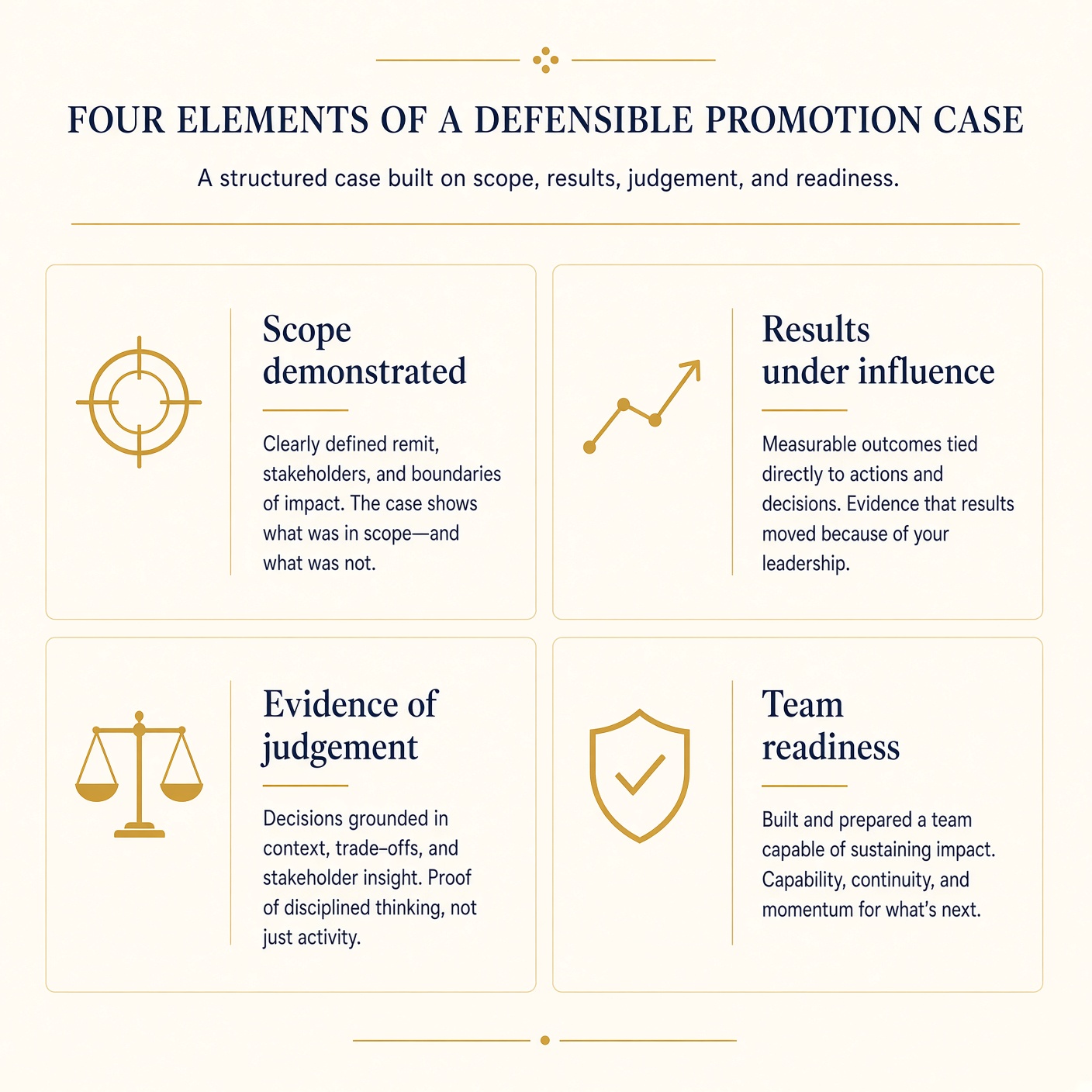
The four elements of a defensible case
1. Scope already demonstrated
Concrete examples of work that matches the next role’s responsibilities, not the current job description.
2. Results under the person’s influence
Outcomes the person drove, described in qualitative or directional terms that can be verified, rather than personal activity counts.
3. Evidence of judgement
Decisions made with incomplete information, trade-offs chosen, and how those choices affected the team or the pipeline.
4. Readiness of the team
What happens to the current responsibilities if the person moves up. A case is stronger when the transition is already partially solved.
How to assemble the case
- List the responsibilities of the target role and map two or three examples against each.
- For each example, write the situation, the judgement call, and the observable result.
- Identify the single strongest piece of evidence and lead with it.
- Anticipate the two objections the next-level manager is most likely to raise and address them in the document.
- Keep the entire case to one or two pages.
Common failure modes
- Writing the case as a performance review of the current role.
- Relying on activity volume or hours worked as the primary evidence.
- Leaving the recommending manager to invent the narrative in the promotion meeting.
- Ignoring the question of who will cover the current seat.
Starter checklist
- Target role responsibilities are written down.
- At least two examples exist for the highest-priority responsibilities.
- Each example includes a judgement call, not only an outcome.
- The recommending manager has reviewed the draft and can explain it unaided.
- The current-team coverage question is answered.
If you have a promotion case that keeps stalling and want it pressure-tested before it goes upward, that is a focused piece of work mentoring can handle.
Start with the $39 intro call